

A wash is not a colour filter added at the end. It changes the shade, surface, softness and sometimes the measurements and balance of the jean. The same instruction can also react differently on two denims that look similar before processing.
That is why “enzyme wash” or “vintage wash” is only a direction. Bulk needs a physical garment to compare against, with the accepted shade, fading, handfeel, trims and after-wash measurements recorded together.
WASH REVIEW CONTEXT
Review the wash as a finished-garment decision
What you are seeing: garment washing in progress at a production partner used within TANTYDENIM’s development and production network.
Why it matters: wash direction affects shade, fading, handfeel, shrinkage and finished measurements, so approval needs a physical washed result rather than a wash name alone.
What should be approved: shade, contrast, fading placement, handfeel, shrinkage effect and the finished garment measurements.
TANTYDENIM’s role: we coordinate wash development and approval with the relevant production partner; this footage does not imply factory ownership.
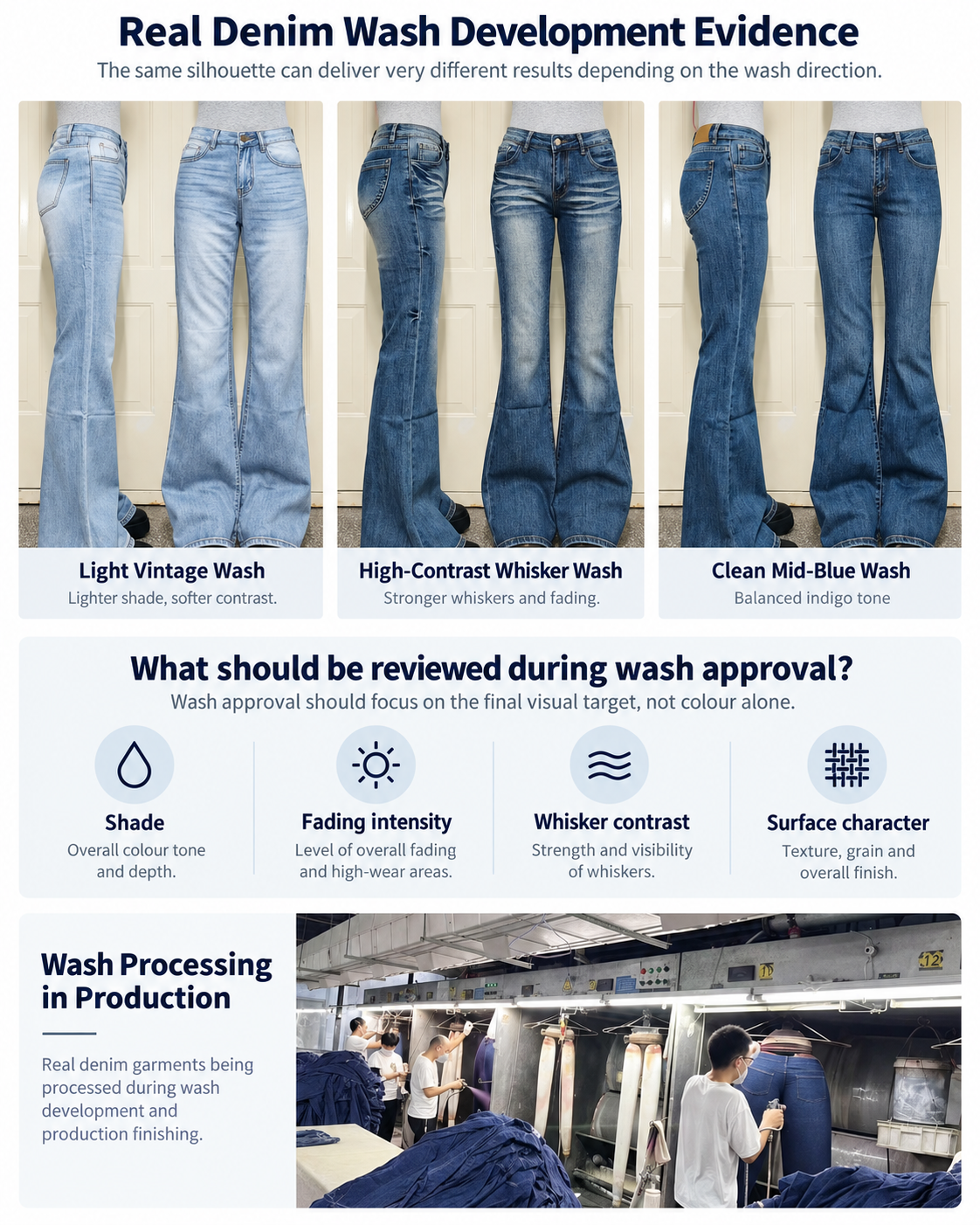
A wash name or swatch cannot show how the finished garment will read across the full silhouette. Before approval, compare the intended shade, fading, surface character, trim appearance and finished measurements on the actual garment.
Use this as a review checkpoint: record clear comments against the finished garment, then retain the approved physical sample and written approval record as the production reference.
Denim wash sample approval: the technical decision reference
Use this reference to separate the visual wash target from the variables that still need sample approval. The approved physical sample should remain the working standard for the actual style.
| Wash parameter | What to define | What to review on the sample |
|---|---|---|
| Base fabric | Composition, weight, structure, stretch and starting colour | How the fabric reacts after washing |
| Overall shade | Target colour depth and contrast direction | Finished shade under consistent viewing conditions |
| Placement effects | Whiskers, fading, abrasion, grinding or other local effects | Position, intensity and balance on the garment |
| Handfeel | Rigid, structured, soft or relaxed direction | Finished touch and wearing feel |
| Finished measurements | Which measurements are controlled after the intended wash | Shrinkage impact and fit against the approved specification |
| Construction appearance | Seams, puckering, topstitching and edge effects that matter visually | Whether washing changes the intended construction appearance |
| Trims and labels | Hardware, patches, labels and finishes exposed to the wash process | Colour, finish, attachment and post-wash appearance |
| Approval standard | Sample version, date, comments and accepted visual reference | Repeatability against the approved wash standard |
Approve a garment, not a wash name
The wash standard should be a physical sample made in the approved fabric and construction. Review its shade, fading placement, seam contrast, handfeel, hardware and finished measurements as one garment.
A front photo is not enough. Turn the sample over, compare the waistband and pockets, check the side seams, and put it on body if the wash has changed the fit. Record the sample version so the wash facility and quality team are looking at the same standard.
Give the wash team something they can compare
Reference photos help, but describe what you are reacting to. Is the base shade right? Should the thigh be cleaner? Are the whiskers too sharp? Do you want a soft handfeel without losing the structure of the leg? Start the brief with the points below:
- Product category and intended fit
- Tech pack or clear reference images
- Preferred denim composition and weight
- Rigid or stretch direction
- Target base shade and contrast level
- Placement of fading, whiskers or abrasion
- Desired handfeel
- Target size range and order quantity
- Branded trims, labels and packaging requirements
Screens and studio lighting can shift the same blue in opposite directions. We use images to discuss direction, then move the approval to a physical sample. Written comments stay with it so later teams know whether a dark waistband, uneven abrasion or muted whisker was intentional.
Choose the result first, then the process
For different denim fits and product categories, review our custom denim product categories and options before selecting a wash direction.
Choose the wash direction according to the required appearance, selected denim fabric and product construction rather than the treatment name alone.
Enzyme wash
An enzyme wash can help soften the fabric and reduce the clean, rigid appearance of raw denim. The final result depends on the denim, treatment conditions and required shade. Buyers should approve softness, colour loss, surface character and finished measurements on the actual selected fabric.
Stone-wash direction
A stone-wash direction is generally used when a brand wants a more worn and washed-down appearance. Development should review abrasion, seam character, shade consistency and any effect on garment strength, shrinkage or measurements.
Laser effects
Laser processing may be used to create controlled whiskers, fading or placement effects. Buyers should specify the position, scale, intensity and symmetry required.
Laser artwork should be reviewed on the correct garment shape because placement can look different across sizes, rises and silhouettes.
Vintage effects
“Vintage” can describe many different outcomes. Instead of approving that word alone, define whether the target is a faded base shade, high seam contrast, local abrasion, whiskers, tinting, distressed details or a softer handfeel.
Put the sample on a table, then put it on a body
Use consistent lighting and compare the whole garment with the reference. Start flat so shade and placement are easy to see. Then check it on body, because whiskers, thigh fading and knee effects can look correctly positioned on a table but move when the jean sits at its intended rise.
- Overall shade: Is the garment too dark, too light, too warm or too cool?
- Shade consistency: Are the front, back, waistband and pockets visually balanced?
- Fading placement: Are whiskers and faded areas positioned correctly?
- Contrast: Do seams, edges and raised areas have the intended definition?
- Handfeel: Is the fabric sufficiently soft without losing the intended structure?
- Surface condition: Are there unwanted streaks, marks, holes or excessive abrasion?
- Construction: Have seams, pockets or hems twisted or distorted?
- Trims: Are buttons, rivets, zippers, labels and patches compatible with the treatment?
- Measurements: Does the finished garment remain within the approved specification?
Record comments precisely. “Make it better” or “more vintage” is difficult to reproduce. Comments such as “reduce thigh fading,” “keep the waistband one shade darker” or “soften the handfeel without increasing abrasion” provide clearer development direction.
Measure again after the wash
The waistband, rise, inseam, hip and leg opening can all move during washing and finishing. Even when each change looks small on a chart, the combined effect can alter where a low-rise jean sits or how a wide leg falls from the hip.
If a washed sample no longer balances correctly, do not assume the pattern alone is wrong. Check the original pattern measurements, sewing allowance, fabric behaviour and wash shrinkage before deciding the correction.
Finished garment measurements should be checked against the approved specification. If measurements are outside tolerance, the cause may relate to pattern dimensions, sewing allowance, fabric behaviour or the wash process.
For more detail on production approvals, review our denim production and quality review process .
How should fit review and wash development be coordinated before the next sample decision?
Review the washed sample as a complete garment, not only as a colour or surface-effect reference. Compare the finished silhouette, key measurements, wearing position and trim appearance with the intended fit and the approved specification.
If the wash changes shrinkage, stretch behaviour or the balance of the garment, record the affected points before deciding the next sample action. Keep the fit comments, wash comments and the sample version together so that the next review uses the same reference.
For a broader review sequence, see our denim fit sample and size-set approval guide.
Shrinkage is part of the wash approval
Different constructions, fibre blends and wash routes can move the waist, rise, inseam and hem by different amounts. The approval therefore needs after-wash measurements alongside the visual standard.
If the fabric or wash route changes later, the old shrinkage result is no longer a safe assumption. Recheck the measurements that control the fit before bulk continues.
If the fabric or wash process changes materially after approval, the affected fit and measurements should be reviewed again before bulk production.
What does an approved wash sample actually guarantee?
An approved wash sample gives production a physical target for shade, fading, contrast, handfeel, visible effects and finished measurements. It does not mean every garment in bulk will be visually identical.
Before bulk, agree the acceptable shade and appearance range, how garments will be compared with the approved standard and what happens to pieces outside that range. The useful promise is a controlled reference and a defined response to variation, not “zero colour difference.”
If the fabric lot, wash process, construction or a wash-sensitive trim changes materially, the affected result should be reviewed again rather than assuming the old approval still applies.
How should bulk wash consistency be controlled?
Bulk production does not need every garment to be visually identical, but the acceptable range should be defined against the approved standard.
The brand and production team should agree how much variation is acceptable in:
- Overall shade
- Fading intensity
- Whisker placement
- Seam and edge contrast
- Abrasion level
- Handfeel
- Finished garment measurements
Bulk inspection should compare production garments with the approved physical standard and the recorded approval comments.
Why must trims be reviewed with the wash?
Buttons, rivets, zippers, labels, patches, embroidery and stitching can change visually or functionally during garment washing.
Metal finishes may become more matte or worn, labels may change colour, patches may react differently from the surrounding denim, and stitching contrast can become more or less visible.
For this reason, visible trims should be reviewed on the intended finished wash rather than only as loose components.
For more detail, review our custom denim trims, buttons, rivets and labels guide .
How should an approved wash standard be recorded?
Keep the approved physical sample and a written approval record. The record should identify:
- Style name or development reference
- Sample version and approval date
- Approved fabric composition and weight
- Approved shade and visible effects
- Approved handfeel
- Finished garment measurements
- Buttons, rivets, zippers, labels and patches
- Acceptable variation or tolerance
- Testing or inspection requirements agreed for the style
If the fabric, wash process, trim or construction changes after approval, the affected sample should be reviewed again. A previous approval should not automatically be applied to a materially different garment.
When should a denim wash be re-approved?
Another wash approval may be needed when any change could materially affect the finished appearance, handfeel, fit or measurements.
Examples include:
- A different denim fabric or fabric lot with different behaviour
- A materially different wash process
- A major change in shade or abrasion level
- A different trim or patch that interacts with washing
- A construction change that affects seam appearance or shrinkage
Use a finished-garment wash reference alongside the wash brief
A written wash brief can define the intended direction, but the review is easier when the team can compare shade, fading, whisker contrast and surface character on the finished garment. See the denim wash-direction evidence for a practical visual reference before the next wash-sample decision.
Denim wash approval checklist
- Confirm the correct fabric and composition.
- Approve the overall shade under consistent lighting.
- Check fading, whiskers and abrasion placement.
- Approve seam and edge contrast.
- Confirm the required handfeel and structure.
- Inspect the complete garment for unwanted marks or damage.
- Check buttons, rivets, zippers, labels and patches.
- Measure the garment after washing.
- Record the approved sample version and comments.
- Retain the physical standard for bulk comparison.
Buyer FAQ: Denim Wash Development
Is approving a wash name enough for bulk production?
No. Terms such as enzyme wash, stone wash or vintage wash describe a general direction. The finished physical sample should define the actual shade, fading, contrast, handfeel, visible effects and measurements expected for production.
Should finished garment measurements be checked after washing?
Yes. Washing and finishing can change the waist, rise, inseam, leg opening and overall garment balance, so finished measurements should be reviewed against the approved specification.
Can a wash change stretch denim performance?
Yes. Washing can affect softness, shrinkage, stretch behaviour, recovery and finished measurements. Stretch denim should be reviewed as a finished washed garment.
Should trims be reviewed with the finished wash?
Yes. Visible trims should be evaluated on the finished garment because washing can change their appearance and their relationship with the denim.
How is bulk wash consistency controlled?
Bulk garments should be compared with the approved physical standard and written approval record. Acceptable variation in shade, fading, contrast, handfeel and measurements should be defined before production.
When should a denim wash be re-approved?
Another approval may be needed when the fabric, wash process, trim or construction changes materially after the original wash approval.
What is TANTYDENIM’s MOQ?
Standard MOQ is 50 pcs per style and colour. Trial orders from 30 pcs per style and colour may be reviewed subject to fabric availability, wash, trims, construction and size breakdown. Mixed sizes are available; the final workable quantity is confirmed for the project. Fabric availability, wash complexity, trims and construction are reviewed before confirming the production route.
How long does sample development take?
Sampling timing depends on product complexity, material availability, wash requirements and revision rounds; the schedule is confirmed after the relevant specifications, fabric, trims and sample requirements are confirmed.
For a first collection, the wash also needs to work with your intended quantity and production route. Our production guidance for emerging brands helps you review those decisions before committing to sampling.
Send the wash reference with the comments behind it
TANTYDENIM coordinates fabric, fit, wash, trims and packaging decisions for women’s denim development. If you already have a wash reference, tell us what must match and what can move. That gives the first trial a much clearer target.
You can review our custom women’s jeans development page , our OEM, ODM and private-label denim development services , and our custom denim development and sampling process .
Ready to discuss a wash direction? Send your reference image, tech pack, target wash, fabric direction and size range through our Request a Quote page.